Alice von Hildebrand’s recent article entitled “Revelation and Curiosity” goes a long way to place the debate over the true meaning of modesty in the larger context of philosophical and theological thought. She highlights the basic distinction between supernature (God and the order of grace) and nature. The precise character of that distinction has always been essential to theological discourse, and the relation between grace and nature has often been the subject of unfettered speculation, to the detriment of the faith. (See, for example, Pelagianism and Jansenism.)
Faith and Reason
I believe that the distinction and relationship between supernature and nature is at the basis of much theological controversy today. I have often made the point, for example, that at times apologists do not sufficiently distinguish their work from Theology and Catechesis. Apologetics is the work of natural reason used to prove the existence of God and the possibility of supernatural revelation, and to show that supernatural truths revealed by God are compatible with reason. Sometimes, when we speak of Apologetics we refer to “proving the faith.” But strictly speaking the faith cannot be proven by reason because by reason alone supernatural truths, such as the Virgin Birth, cannot be comprehended. Ultimately, grace is the cause of Theological Faith. We are only certain of the supernatural truths God has revealed because He has given us the grace and we have assented to that grace.
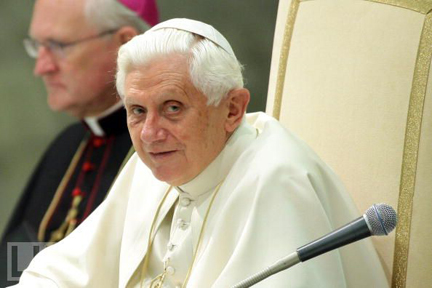
This is not to say that reason is extraneous. Not at all. In the Catholic view of things, faith and reason are mutually compatible, although through faith we are able to know things that we could not know by reason alone. Hence, faith is both reasonable and transcends reason, just as grace builds on nature but also transcends it. Reason shows us that what God has revealed is compatible with nature. In other words, God is not arbitrary. The natural law written in our hearts is confirmed by supernatural revelation not contradicted by it. Pope Benedict, in his speech at the University of Regensburg has drawn our attention to the rupture between faith and reason: in the West by the denial of faith on the pretext of science; and in Islam by the fideism by which God’s revelation contradicts the natural law.
Apologetics, Theology and Catechesis
Apologetics is a kind of precursor to theology. Its principle tasks are to prove the existence of God and to show that supernatural revelation is possible, tasks that can be accomplished by reason alone. Secondarily, apologetics shows the reasonableness of what God has revealed.
However, Apologetics and Theology are truly distinct. Whereas the work of Apologetics is prior to faith, Theology begins with the assent of faith and builds on it. So also Catechesis builds on faith. One who has been received into the catechumenate is preparing for Baptism because he has a conviction of the true faith. Even though that person does not have the Theological Virtue of Faith, which is infused at Baptism, he must nevertheless be making acts of faith with the help of actual graces. Catechesis then extends beyond Baptism as a preparation for the other sacraments, and then again as a kind of ongoing deepening of the faith for those who desire to grow spiritually, always on the presupposition that the whole deposit of the faith is already held to be true.
Recipes for Disaster

In practice, however, especially in times when secularist ideology holds sway, the work of Apologetics, Theology and Catechesis are mixed together by the same teacher, very often in the same presentation. This is perfectly legitimate and necessary because even though the person catechized has already assented to the faith, his formation is often spotty, and the spirit of the world is continually challenging his convictions.
And so, while the mixture of these disciplines is legitimate and necessary, it demands that the teacher be aware of their distinction and not confuse Apologetics with Catechesis and Theology. The danger of confusing the disciplines lies in the possibility of the imbalance between faith and reason. This is precisely the warning given us by Pope Benedict at Regensburg. When Apologetics is substituted for Catechesis, reason usurps the place of faith: nature is substituted for supernature. This is the fault of Western rationalism. When Catechesis is substituted for Apologetics, the legitimate aspirations of reason are not met: supernature does not build on nature but supplants it. This is the fault of Islam.
Apologies

Clearly, the modern Western tradition favors reason over faith. Thus, Apologetics is left in the precarious position of defending the faith without turning Apologetics into what is commonly meant by the word “apology.” Since, ultimately grace is the cause of Theological faith, the rationalist mind will have to cease to be rationalist before it can assent to the truths revealed by God. Simply indulging its vice is no solution; rather such indulgence only enables the vice. An apologist for Theism has said: “You can lead an atheist to evidence, but you can’t make him think.” In reference to our problem, we might return nearer the original metaphor and say: “You can lead a rationalist to living water but you can’t make him drink.” Thinking is not enough. Enthusiasm is not enough. In the end, one must assent to something he does not fully understand, and only the power of grace can make this possible.
As it turns out, the subject of Christian chastity is particularly susceptible to “apologies” and rationalism, since it is such a hot button issue, and one that is impossible to assimilate without grace. As long as one is closed to grace, no amount of reason is going to solve problems with chastity. We are tempted to look for shortcuts, tempted to go the extra mile to make chastity look appealing. The whole question here is one of balance. On the one hand, the Church has recognized the need to present chastity in a way that does not reduce it to negative precepts, but no matter how it is presented, as long as its fullness is not adulterated, it remains a “hard saying” (cf. Jn 6:60).
The truths of the faith are supernatural and while they are compatible with reason they absolutely transcend it. Super, from the Latin, means “above and beyond.” To “comprehend” something means to “hold it in one’s hand.” That we will never do with the truths of the faith, and it is why, as Alice von Hildebrand points out, that curiosity in respect to what God has not revealed, can be such a vice.
A Hard Saying

The idea of the Blessed Virgin ejecting a bleeding placenta at the birth of Jesus was surely intended to aid one’s assent to the truth that marriage, sexuality and procreation are beautiful and holy realities. But God deprives us of what indulges curiosity precisely because we must assent on the authority of His word. The Virgin Birth is a case in point. It is very significant, I believe, that an apologist is trying to defend the “hard saying” of chastity by minimizing the “hard saying” of the Virgin Birth.
Among Catholics there is much confusion as to the precise meaning of the Virgin Birth. It is not to be confused with the Virginal Conception of Our Lord. The Church, from the earliest times, has articulated the Perpetual Virginity of Our Lady as pertaining to three distinct moments: before the birth of Jesus (ante partum), during the birth of Jesus (in partu), and after birth of Jesus (post partum). Virtually every time the magisterium has spoken on the subject, this threefold distinction is made. This teaching is derived from the early fathers of the Church, who maintained, defended and made the teaching a universally held truth of the Catholic Church.
The Virginity of Our Lady “before the birth of Jesus” (ante partum) refers to the Virginal Conception, namely, that Jesus was conceived in the womb of Mary by the power of the Holy Spirit, and not by the seed of man. That is fairly clear. It is also clear that the Virginity of Our Lady “after the birth of Jesus” (post partum) refers to the fact that Our Lady never had sexual relations, even after the birth of Jesus, a fact that many Protestants deny. For many Catholics, unfortunately, these two points say everything that is to be said about the Virginity of Our Lady and such Catholics proceed to explain away the Virginity of Our Lady “during the birth of Jesus” (in partu). They say that the Virginity of Our Lady in partu, just refers to her “spiritual virginity,” an idea that is contrary to magisterial clarifications. Or, they say, that the “Virgin Birth” is a misnomer for “Virginal Conception.”
Explaining It Away
But the middle moment of Our Lady’s Perpetual Virginity is real and its reality is the only viable reason why the Church would continue to insist on a threefold distinction as opposed to a twofold one. In fact, unless the Virginity of Our Lady in partu means exactly what the Fathers of the Church said it means, namely, miraculous birth, then it means nothing at all and as a statement of faith is completely superfluous and meaningless.
Theologians can speculate all they want on what does or does not belong to the essential matter of the Church’s definition of the Perpetual Virginity, but the only reason anyone would doubt that the birth of Jesus is any less miraculous than the conception is a lack of faith. People will cite this or that theologian, whose convoluted explanation of the Virgin Birth allows for a natural birth, including pain and afterbirth, but they cannot cite any ancient authorities or magisterial affirmations. They do not want to believe the full truth of the Virgin Birth because it is hard to believe—and because it is not convenient doctrine for Apologetics.
In respect to this modern attitude toward the Virgin Birth, reason has supplanted faith, Apologetics has trumped Theology and Catechesis. Dr. von Hildebrand is exactly correct:
That a virgin could give birth and remain a virgin would never have crossed man’s mind. It is a fact inaccessible to human reason. It has a divine seal: it is mysterious, miraculous, can only be known by revelation, accepted on faith. It calls for trembling adoration, the only adequate response.
In man’s craving to penetrate behind the “veil” and know what is in no way necessary for our salvation, many are tempted – unwittingly – to cross the abyss separating the supernatural from the purely natural.
The assertion that Our Lady ejected a bleeding placenta is doubly rationalist. It firstly, vacates the meaning of the Virgin Birth, and secondly, it does so precisely to make Christian marriage and parenthood look more appealing. Somehow a natural birth of Jesus from Mary is supposed to show forth the glory of human procreation. Unfortunately, this “glory” is void of the supernatural meaning that God intended for the earthly birth of His Only Begotten Son.
The Great Sign
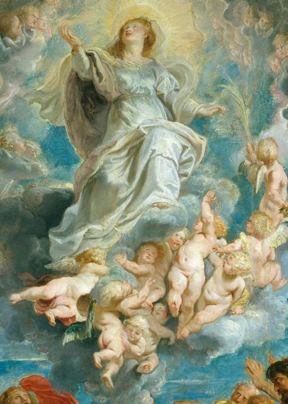
As Dr. Von Hildebrand says the Virgin Birth is a “divine seal,” a sign that is exactly parallel to and no less miraculous than the Resurrection. The Church has fought vigorously against every attack on the Perpetual Virginity of Our Lady, just as She has fought every attack on the Resurrection: because these are the principle signs that God has chosen as “divine seals” confirming the identity and mission of the Son of Mary.
Christian chastity shares in the character of the Virginity of Mary, whether that chastity involves perfect continence or marriage and parenthood. Chastity has a supernatural character. It is not merely natural. And that means that it can only be lived through the power of God’s grace.
It is a necessary and commendable endeavor of apologists to formulate better arguments and more appealing presentations of the faith in order to more effectively persuade human minds and hearts. However, apologists need to know their limits and to mortify their curiosity. Specifically, in respect to chastity, and more so toward the chastity of Our Lady, silence and reverence is in order.
Sometimes discussions on the blogs concerning Our Lady’s Perpetual Virginity have sounded like clinical examinations, as though the True Ark of the Covenant were brought into a gynecological theater and placed on the examination table. No one seems to have an inkling of how inappropriate this is. The Ark is placed behind the veil of the Holy of Holies for a reason. Uzzah was struck dead when he touched the Ark for a reason. God teaches us how to live the holy mystery of chastity through silence and reverence for a reason.
The saints have meditated on the beauty of the Blessed Virgin since the beginning of the Christian era. Nothing is more beautiful than God’s masterpiece. Yet none of the saints had the slightest inclination to remove the veil, or to speculate on the Virgin Birth in a clinical manner so as to makes its truth more palatable. Silence in the face of such a mystery is true mysticism. It is a place where those who persevere might find true contemplative ecstasy.
Sex talk is not going to solve the problem of chastity. Too much talk vacates mystery. The wordy prosaic explanation of a poem or painting is not the same thing as admiration. Oftentimes such explanations ruin the aesthetic effect of art. The signs God has provided need to be treated with the appropriate admiration. St. John Chrysostom said it best in a Christmas homily:
Though I know that a Virgin this day gave birth, and I believe that God was begotten before all time, yet the manner of this generation I have learned to venerate in silence, and I accept that this is not to be probed too curiously with wordy speech. For with God we look not for the order of nature, but rest our faith in the power of Him Who Works.
The art of Apologetics is not just about what to say and how to say it. It is also about when to be silent and make an opportunity for reverence. Conversion is God’s work. Sometimes we just need to get out of the way.

 Christopher West has quoted me in his new book, At the Heart of the Gospel: Reclaiming the Body for the New Evangelization.
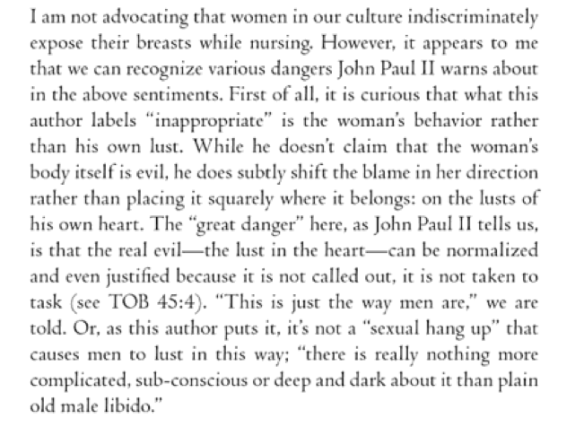

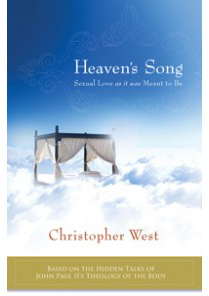 After all West speaks about the language of the body precisely in terms of sexual values. Those values, sexual desire, sexual pleasure and the conjugal act itself point beyond themselves to desire for unity with God, the bliss of heaven and the mutual self-giving of God and the soul. So when West suggests that we should have a holy fascination with the body and sex, as he does, for example in



 Mary Victrix
